
Course 1
- Module 1
The Architecture of Meditation

Lessons
8 + 1 Bonus
Duration
3 - 4 Hours
Level
Overview
Getting to meditation mastery can be compared to climbing a mountain. Many trails go up the mountain. We have found that almost all meditation practices tend to fit into one of four fundamental categories. Choosing the right style of meditation practice can have a dramatic effect on how much you enjoy the practice and how easily you reach mastery.

In this foundational module, you will learn about the four fundamental styles of meditation and the four levels of meditation mastery. This is not merely intellectual knowledge. It is a map that will help you choose the best practice suited for your deepest intentions.
Module Lessons
9 Lessons · 2 Bonus
Discover the scientific framework that distinguishes one meditation style from another — and why the distinction matters for your practice.
Each style contains four levels or stages of practice. The levels will help you understand where you are on the spectrum.
This is the most studied style in modern neuroscience. Train the stabilizing force of sustained attention — the foundation of all meditation.
Cultivate compassion, loving-kindness, joy, and equanimity. Science shows this style uniquely activates the heart-brain connection.
Awareness resting in itself without object. The bridge between ordinary consciousness and the deepest dimensions of mind.
The apex of contemplative practice, now beginning to be measured in the laboratory. Explore the neuroscience of awakened awareness.
Select a style of meditation based on your intention — stress reduction, insight, compassion, or awakening. A practical decision guide.
“The quality of your life is determined by the quality of the questions you ask yourself.” – Tony Robbins
Bonus
Flow States vs. Nondual Awareness
Explore the critical distinction between peak performance states and genuine contemplative awakening — a question that sits at the heart of IMBR research.

How The Journey Begins
We have found that almost all meditation practices tend to fit into one of four fundamental categories. Choosing the right style of meditation practice can have a dramatic effect on how much you enjoy the practice and how easily you reach mastery.
In this foundational module, you will learn about the four fundamental styles of meditation and the four levels of meditation mastery. You can see typical practices for each of the four styles at the bottom of the pyramid. This is a map that will help you choose the best practice suited for your deepest intentions.
Where Meditation Takes You
Buddhism speaks of liberation from attachment and the illusion of a permanent self. Hindu traditions speak of realizing the deeper Self beneath egoic identity. Christian contemplatives speak of surrendering personal will into communion with God. Sufis speak of dissolving into divine love. Taoist traditions speak of alignment with the underlying flow of reality. Zen often refuses to explain at all, insisting that reality must be encountered directly before language fractures it into concepts.
Underneath the countless methods, philosophies, symbols, and rituals of meditation traditions across the world lies a surprisingly similar long-term aim: the transformation of the relationship between consciousness and the self that consciousness imagines itself to be.
Ordinarily, human beings live inside a continuous psychological construction. Thoughts arise, and we call them "my thoughts." Emotions surge, and we call them "my feelings." Memories accumulate into a story, and we call the story "me." We spend decades defending, enlarging, fearing for, and negotiating on behalf of this identity. Most suffering emerges from this structure: craving for what strengthens the self, fear of what threatens it, resistance to change, attachment to certainty, endless comparison, endless becoming.
Even in good conditions, the mind can manufacture suffering; even in terrible conditions, the mind can find freedom. The path of meditation leads to openness, peace, and connectedness, no matter what the outside circumstances, as one is freed from contractions around desires, fears, opinions, memories, ambitions, wounds, and identities.
Over long practice, practitioners often report subtle but profound shifts. Thoughts continue, but they no longer possess the same authority. Emotions arise, but they pass more fluidly without defining identity. The boundary between "self" and experience softens. Awareness becomes less entangled in stories and more rooted in direct presence. Compassion increases naturally because the rigid separation between self and other weakens. Fear of uncertainty diminishes because experience is no longer filtered entirely through the needs of ego preservation.
This transformation is rarely dramatic or permanent in a simple sense. It unfolds unevenly, sometimes painfully. Meditation does not erase personality or eliminate human vulnerability. Rather, it changes the center of gravity from which life is experienced.

How IMBR teaches Meditation Techniques
Most meditation schools teach the “how to” of meditation techniques. We teach how all the techniques relate to each other in an “Architecture of Meditation” that is summarized in the IMBR Pyramid.
If you are a student, you will be better prepared to find a teacher and training that fits you. If you are a teacher, you will be better prepared to help prospective students out of their confusion around the hundreds of meditation trainings available to them.
Many Paths, One Destination
Getting to meditation mastery can be compared to climbing a mountain. Many trails go up the mountain, and all end at the summit.

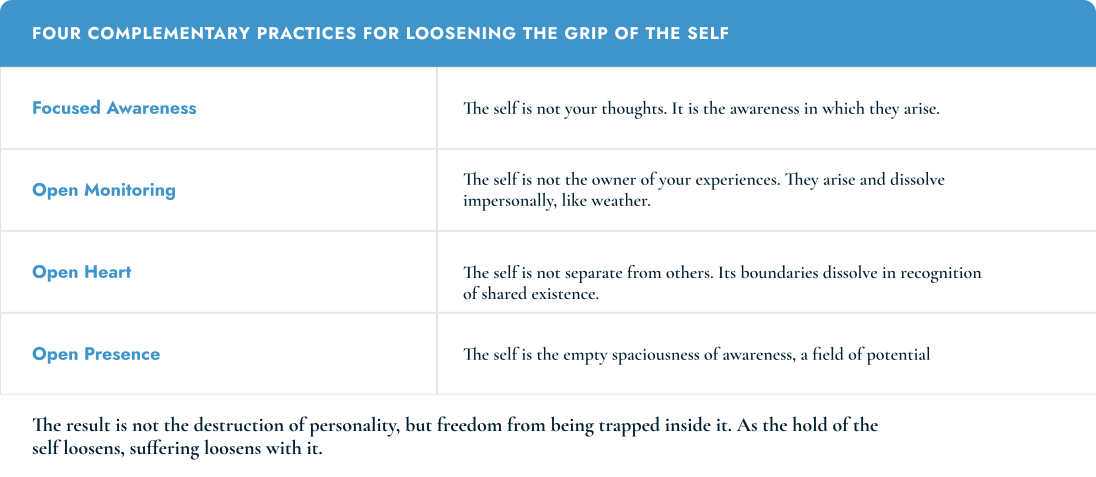
IMBR research has distilled the plethora of meditation practices into four major styles of meditation — each teaches a core skill for loosening the grip of the self.
Focused Awareness
practices train stability. By repeatedly returning attention to the breath, mantra, or body, for instance, the meditator begins to see that thoughts and impulses do not have to control awareness. The mind becomes calmer and less identified with its endless internal narration.
Open Monitoring
practices deepen this insight by observing thoughts, emotions, and sensations as passing events rather than personal possessions. Anger becomes not "my anger," but simply anger arising and passing away. The practitioner begins to see the self less as a fixed entity and more as a constantly changing process.
Open Heart
practices soften the boundary between self and other. By cultivating care for all beings, the meditator weakens the ego's habit of placing itself at the center of experience. Isolation decreases, connection grows, and the heart becomes less defensive and fearful.
Open Presence
practices invite a profound relaxation of mental effort altogether. Rather than concentrating on an object or analyzing experience, the practitioner rests in simple, open awareness itself. Experience unfolds naturally without constant grasping, controlling, or identifying. In these moments, the sense of being a separate self can soften dramatically, replaced by a feeling of spaciousness, intimacy, and ease.

Four Levels of Development
IMBR research classifies meditation development into four levels:
Level 1
Relaxing into Calm
You settle your body, calm your nervous system, and shift from fight/flight to rest/digest mode. The goal is simply to release tension and feel safe while staying present. This foundation stage typically takes tens of hours of practice.
Level 2
Efforting to Develop Technique
You actively direct attention, notice distractions, and intentionally bring focus back repeatedly—the practice requires visible effort. This stage takes hundreds of hours and is completely normal; effort means you're learning.
Level 3
Effortless Technique
The technique becomes automatic and flows naturally with minimal effort, like muscle memory for the mind. You experience greater clarity, ease, and emotional balance—signs of genuine progress.
Level 4
Nondual Awareness
The separation between observer and observed dissolves; there's awareness without a sense of "you" watching. The technique drops away entirely and qualities like compassion and clarity arise spontaneously. This advanced state emerges naturally from years of consistent practice and cannot be forced.
4 Styles x 4 Levels = 16 Meditative States
We believe that any research into the mind/brain correlates of meditative states must consider a minimum of 16 core meditative states. We are sure there are more. The map is not the territory, but it is useful for navigation. Please join us as we explore the 16 core meditative experiences.
The 16 states are inside of the pyramid. We picture them in a pyramid rather than a grid because the style converge as you get more advanced. We revisit the whole journey at the end of this module.
